About the AIxBio Fellowship
A 10-week, fully funded programme at Cambridge, for researchers and entrepreneurs working on important problems at the intersection of advanced AI and biosecurity.
Overview
- Format
- 10 weeks, full-time, in person.
- Location
- Cambridge, UK, with a dedicated workspace alongside the fellowship cohort.
- Dates
- –
- Funding
- £10,000 total stipend + travel & visa costs will be covered.
- Cohort
- 15 fellows.
- Support
- An expert mentor matched to your project, a dedicated ERA Research Manager, research workshops, and community and wellbeing support.
- Eligibility
- Applicants aged 18+ from a wide range of backgrounds and career stages. Prior formal research experience is not required.
- Applications
- Opening soon for Winter 2027.Register your interest
AIxBio fellowship tracks
For Winter'27, we expect to accept ~15 fellows across three tracks: Research, Placement and Founding. We are broadly excited to support individuals who are energised by taking ownership of concrete biosecurity problems.
-
Research
Turn an open biosecurity question into a tractable project. Produce evidence, methods or tools that can change research or policy decisions.
Possible outputsAn evaluation method, a safeguard study or a policy analysis, developed with an expert mentor.
-
Placement
Embed with a biosecurity team and own a real workstream in research, engineering, policy or implementation.
Possible outputsA screening tool, an evaluation workflow or analysis for a team’s decisions, scoped around its priorities.
-
Founding
Test whether a neglected biosecurity gap warrants a dedicated organisation — and what it would take to build one.
Possible outputsAn initial tool or pilot, tested with potential users to establish whether a dedicated effort is worth pursuing.
Built to accelerate your progress
-

Research Support
We want to help our fellows identify a tractable piece of an important biosecurity problem and make serious progress on it. Therefore, each fellow receives personalised research support from two key sources at ERA: 1) dedicated Research Managers who work closely with fellows on project scope, milestones, research strategy and execution, and 2) expert mentors who bring specialised technical or policy expertise, challenge assumptions and help connect the work to what is already happening in the field.
We also run practical workshops on research communication, writing and other skills that help fellows execute and communicate their work effectively.
-

Access to the field
AIxBio work sits across several different communities: biosecurity, frontier AI safety, policy, and more, spanning academia, government and industry.
Throughout the programme, we bring fellows into contact with researchers working across these areas through talks, workshops, project feedback and direct introductions where useful. Our goal is to give fellows access to the people, context and expertise they need to do better work.
For particularly promising projects and fellows, we can also provide a route to continue beyond the ten-week programme through ERA's longer-term in-house Research Scholar positions.
-

Community
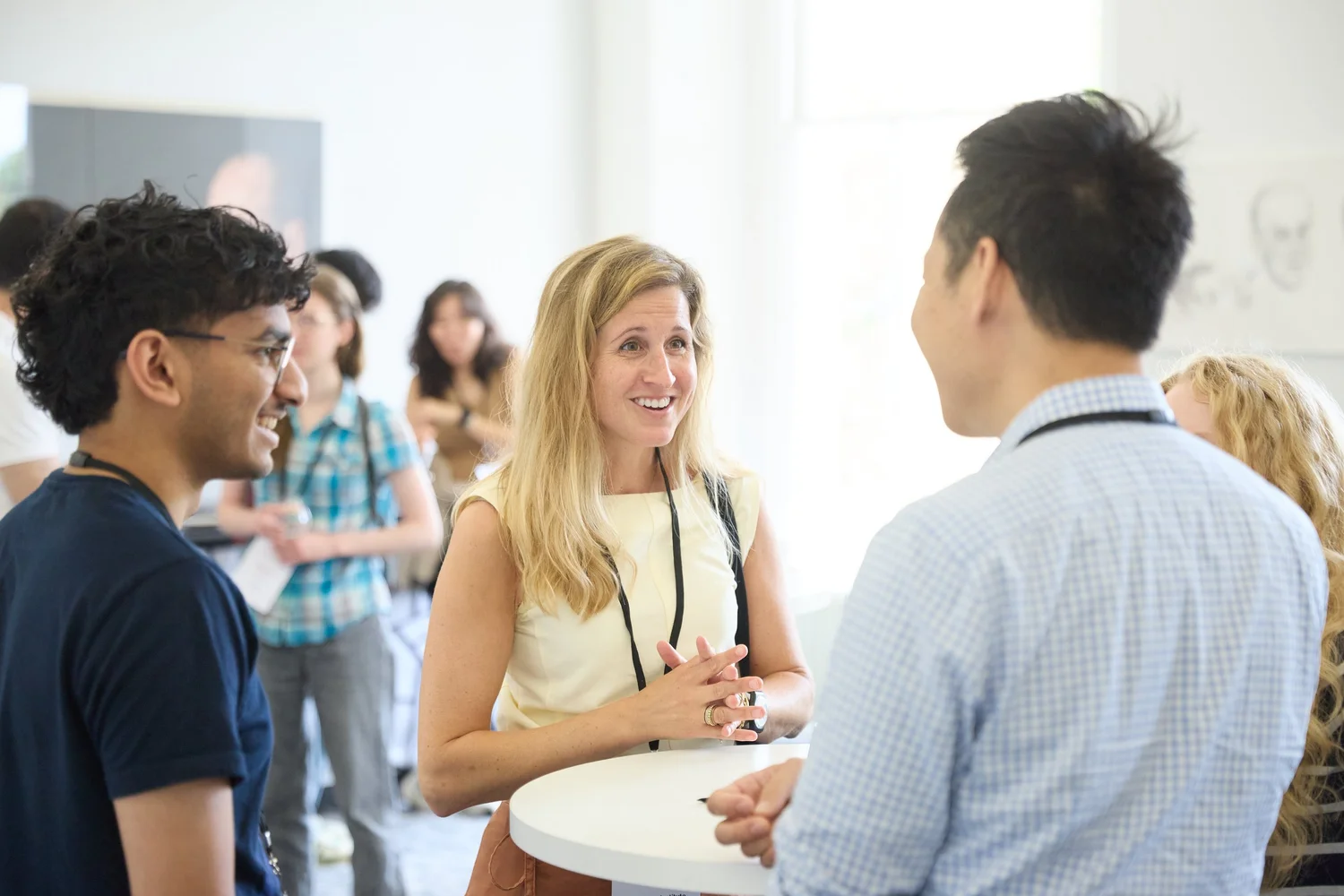
We bring together a strong community dedicated to biosecurity at Cambridge. Our fellows work together from ERA's Cambridge office, alongside others tackling problems across AI safety and biosecurity. We deliberately run the programme in person: some of the most useful research conversations happen outside scheduled meetings, when someone notices a connection, challenges an assumption or knows exactly the person you should speak to.
We also organise regular talks, workshops, dinners and social events, and connect fellows with the wider Cambridge research community and ERA's other programmes (such as ERA:AI & FASR).
-

Full Operational Support
We want fellows to be able to focus fully on their work. Our fellows receive a £10,000 stipend for the ten-week programme, alongside meals during working hours, travel support and full visa sponsorship for international participants from most countries.
Our fellows also have access to our office workspace, a dedicated project funding pot, and compute where this is useful for their work. Our operations team can also support with the practical logistics of relocating to and living in Cambridge for the programme, and any other administrative questions. We also have a dedicated Community team.
Application Process
Applications are open for our Winter 2027 Fellowship and close on October 19th, 2026. If you'd like to hear about future cycles, you can express your interest and/or sign up to our mailing list below.
If you have any questions, we recommend reading through our FAQs, and then emailing us at biosecurity@erafellowship.org.
-
The first stage consists of a short written application. We ask about your background, the problems you are interested in, and how you think about questions at the intersection of AI and biosecurity. We care substantially more about the quality of your reasoning than polished application writing.
-
Shortlisted applicants will be invited to an interview with the ERA team. We use the interview to understand how you reason about difficult problems, explore your research interests in more depth and assess where the fellowship could most usefully support you.
-
Some of our mentors and placement organisations would like to run short work tests ahead of selecting candidates. At this stage, you may expect to do between 0-3 work tests depending on your track.
Who we’re looking for
The AIxBiosecurity Fellowship backs people working to reduce global catastrophic biological risks (GCBRs), especially engineered pandemics and biological threats amplified by increasingly capable AI. We welcome applicants across career stages, from graduate students and early-career researchers to experienced researchers, engineers and founders.
Applicants must be 18 or older; there are no other formal eligibility restrictions. We welcome applicants globally and provide visa support. Prior formal research experience is helpful, but not required.
The profiles below are illustrative, not exhaustive. If your expertise could help reduce catastrophic biological risk — even if your background does not fit neatly into one of these categories — we encourage you to apply.
-
AI, machine learning & software
Researchers and engineers who can build, evaluate or stress-test AI systems with consequential biological capabilities. You might work on biological foundation models, LLM evaluations, biosecurity safeguards, sequence screening or scientific software. We’re especially interested in people who can design rigorous experiments, develop robust benchmarks and build reliable tools to evaluate and mitigate biological risks from AI.
-
Virology, molecular biology & biophysics
Scientists who understand biology deeply enough to tell us where AI capabilities become genuinely consequential. Virologists, microbiologists, molecular biologists, biochemists and biophysicists can bring crucial judgement about pathogens, biomolecular systems and experimental reality — helping identify dangerous capability gains, design meaningful evaluations and determine whether proposed safeguards would work outside the lab.
-
Policy, governance & security
People who can turn technical understanding into safeguards that work in the real world. This could mean designing standards for DNA synthesis screening, developing governance for powerful biological AI models, improving procurement and deployment of biodefences, or testing whether organisations actually comply with existing safeguards. We welcome policy researchers, lawyers, security professionals and technically minded generalists who can bridge evidence and implementation.
-
Founders
People who see a neglected biosecurity problem and want to build the organisation that solves it. The fellowship can be used to validate an idea, understand users and buyers, test its hardest technical assumptions, find collaborators and work out a credible route to funding and deployment. We welcome both aspiring founders and existing teams exploring ambitious companies or nonprofits at the AI–biosecurity frontier.